
Cost Per Use: Are Expensive Nonstick Pans Worth It?
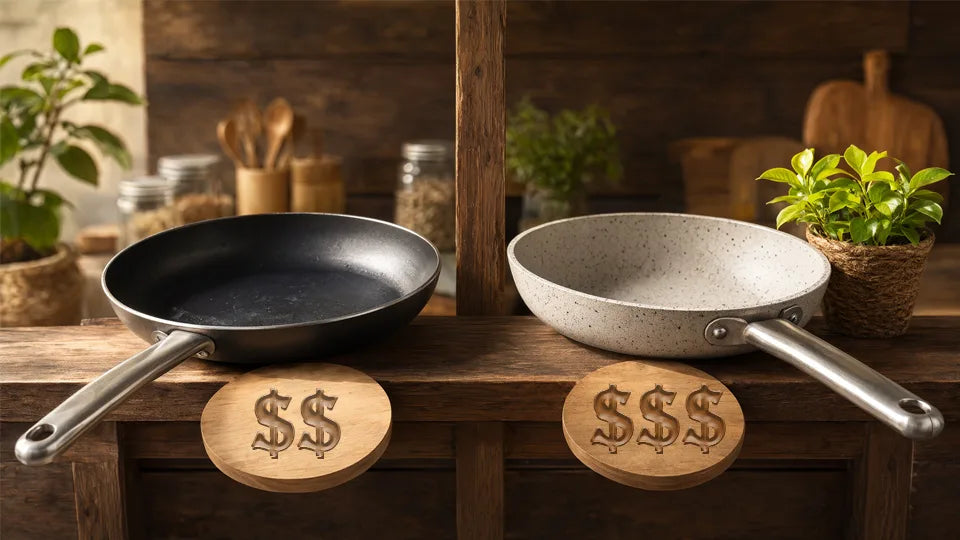
Two pans sit on a shelf. One costs $30. The other costs $100. Which one is actually cheaper to own?
The answer depends on a number most comparisons never mention: how many times you cook. Not just how many years you keep the pan or what it is made of — those matter too, but they all feed into the same calculation. This guide gives you the formula. Plug in your own numbers, because the same pan can be a great deal for one cook and a waste of money for another.
What "Cost Per Use" Actually Means
Cost per use is your total spend divided by the number of times you actually cook with the pan. It is not the same as cost per year, and it is not the same as the sticker price. Most comparisons skip this step, which is why they end up arguing about the wrong number.
The formula
Cost Per Use = Purchase Price ÷ (Weekly Uses × 52 × Years of Life)
Plug in 3 numbers and you get a real figure. For example, a $50 pan used 2 times a week for 3 years works out to about $0.16 per use.
Why cost per year is not enough
Cost per year assumes the pan is in steady use. It rarely is. A pan you use five times a week is doing something very different from a pan you use once a month, even if both sit on the same shelf for ten years.
Here is a purely hypothetical example to show how much frequency matters. Take a $200 pan and assume it lasts 10 years:
lUsed 5 times a week, 2600 uses, $0.077 each.
lUsed once a week, 520 uses, $0.385 each.
Same pan. Same price. And about five times the per-use cost, purely because of frequency.
Two numbers you need before you compare anything
Before you look at any pan, answer these two questions about your own kitchen:
1. How many times a week do you actually use it?
2. How long did your last pan of the same type hold up before you replaced it?
Without those, any comparison you read online, including this one, is just guesswork.
The Real Lifespan of a Nonstick Pan
A cheap nonstick pan typically lasts six months to a year and a half under regular use.
Quality nonstick or hybrid nonstick cookware may last longer than budget cookware, but its lifespan still depends on its construction, use, and care. Under regular use, most fall somewhere in the three to seven year range, depending on coating type, cooking temperature, and how carefully they are handled.
The range is wide because the coating fails before the body does in every case, but how long it takes depends on construction, temperature, utensils, cleaning, and storage. A pan cooked at low to medium heat and washed by hand sits at the top of the range. One subjected to high heat or other improper use sits at the bottom.
What speeds up coating wear
Overheating or heating an empty pan
Sharp metal utensils
Stacking pans without a protector between them
Aerosol cooking sprays that bake onto the surface
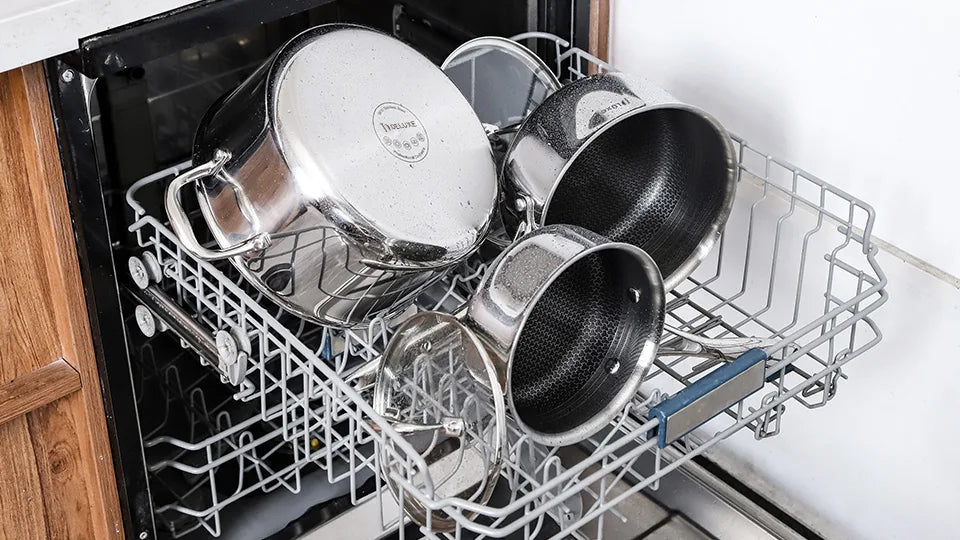
Abrasive dishwasher detergent
How to tell when it is done
lThe center sticks while the edges still release cleanly
lThe coating shows visible scratches or patchy discoloration
lFood no longer releases even with plenty of oil

What You Also Pay For
Beyond the purchase price, you pay for replacement frequency, cooking failures, and time. These are real costs even when they never show up on a receipt. Most cookware articles ignore them entirely.
Replacement frequency
A cheap nonstick pan gets replaced far more often than a durable one. Over ten years, that difference in count adds up to a difference in total spend that most people never calculate before buying.
Cooking failures
Sticking food breaks. Broken food burns. A single ruined dinner wastes $10 to $20 in ingredients. If that happens five times a year, you are losing $50 to $100 annually, before counting the takeout you order to replace the meal. A quality coating reaches the same state eventually, just later, so the same cost is spread thinner across its longer life.
Time and consumables
A degrading coating needs more scrubbing, longer soaking, and eventually a replacement purchase. Some cookware also asks for silicone or wood utensils to protect the surface, which is another purchase. The time side of this is hard to measure precisely, but it is real.
Running the Numbers: Three Scenarios
Below are three scenarios using stated assumptions. Swap in your own numbers — the point is to show what a fair comparison looks like, not to sell you a conclusion.
Scenario 1: A $30 nonstick pan
Assumptions: replaced every 1 year, used 5 times a week.
Pans needed over 10 years: about 10
Total spend: about $300
Total uses: 5 × 52 × 10 = 2600
Cost per use: about $0.115
Scenario 2: A $100 single pan
Assumptions: lasts 5 years (midpoint of the 3 to 7 year range from the lifespan section above), used 5 times a week.
Pans needed over 10 years: 2
Total spend: $200
Total uses: 2600
Cost per use: about $0.077
The gap is now $0.115 versus $0.077 per use — about $10 a year in purchase price ($300 versus $200 over the decade), with the eight extra purchases and the failed dinners pushing the real difference wider from there.

Scenario 3: Sets — why the piece count changes the math
You cannot compare sets by price. At the same price, one set might have 6 pieces and another might have 3. The math that matters is effective cost per piece:
Effective Cost Per Piece = Set Price ÷ Pieces You Actually Use
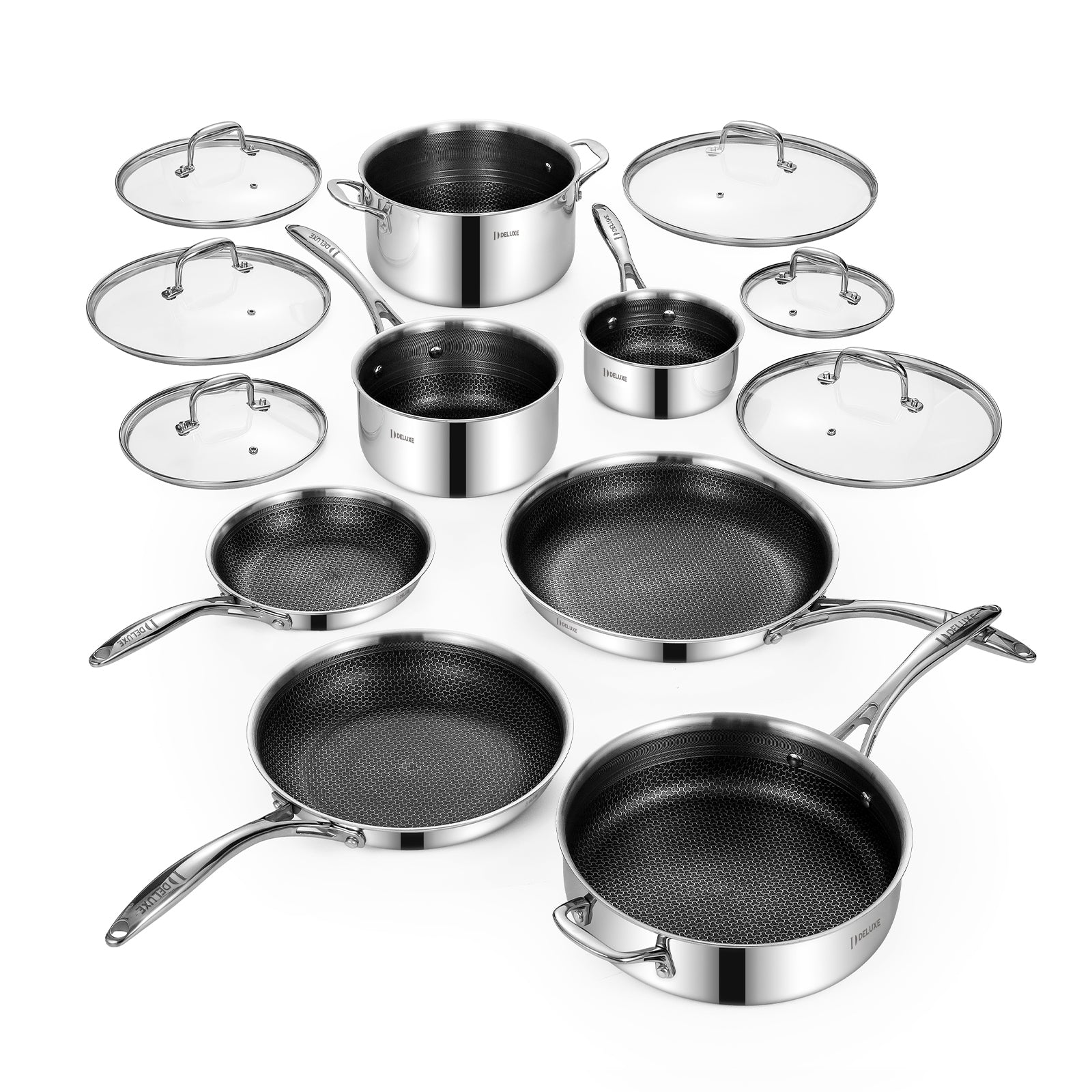
A $150 six-piece set where you use three pieces costs $50 per piece. A $300 three-piece set where you use all three costs $100 per piece. Divide by total piece count and the first looks four times cheaper. Divide by the pieces you actually use and it is only twice as cheap.
Lifespan then separates them further. Budget pieces last about a year; quality pieces last about five. But that lifespan advantage only pays off if you actually use the pieces. If you buy a $300 set and reach for one piece, the effective cost jumps to $300 per piece, and the comparison flips.
Do not divide a set's price by its piece count. Divide it by the number of pieces you will actually reach for on a regular basis.
Before buying a set, check the sizes, the meals you cook most often, storage space, cooktop compatibility, and the care each piece requires.

What these numbers assume
Two numbers decide everything: how many times a week you will use the pan, and how long pans like it last in your kitchen. You already have both — they are the answers to the two questions at the top of this guide.
| Frequency | $30 pan | $100 pan |
|---|---|---|
| Daily (7 times a week) | $0.082 | $0.055 |
| Most days (5 times a week) | $0.115 | $0.077 |
| Few days (2 times a week) | $0.288 | $0.192 |
| Rarely (0.5 times a week) | $1.15 | $0.77 |
Under these assumptions, the quality pan wins at every frequency. The per-use gap grows as frequency drops ($0.03 daily, $0.38 rarely), but the annual difference stays at roughly $10. At that scale, practical factors start to outweigh the math — which is exactly what "When Cheap Pans Do Make Sense" covers.
What if the lifespans are different?
Same usage (5 times a week, 10 years), four outcomes:
| Pan and assumed lifespan | Pans purchased | Total purchase cost | Cost per use |
|---|---|---|---|
| $30 pan, lasts 1 year | 10 | $300 | $0.115 |
| $30 pan, lasts 2 years | 5 | $150 | $0.058 |
| $100 pan, lasts 3 years | 4 | $400 | $0.154 |
| $100 pan, lasts 5 years | 2 | $200 | $0.077 |
Two things stand out. If a $30 pan lasts two years, it beats a $100 pan that lasts only three. And if the $100 pan lasts the full five, it wins by a wide margin. The price alone tells you nothing — what matters is how each pan's price compares to its actual useful life.
When Cheap Pans Do Make Sense
The math above does not mean cheap pans are bad. It means the value of a pan depends on the situation, not on an absolute ranking. Here are five situations where a cheap pan is the right buy.

You cook less than once a week
At low frequency, the per-use math still favors the quality pan, but the total gap stays at only about $10 a year — small enough that other factors take over. A cheap pan performs well enough for occasional cooking. The lower upfront price may make replacement easier to budget for, so you don't need to worry about the coating. At this frequency, you are not buying performance. You are buying convenience.
You are renting, moving, or sharing a kitchen
You may not want to pack a heavy pan every time you move. In a shared kitchen, dishes get used and washed by other people, and mistakes happen. An inexpensive pan keeps both the replacement cost and the mental burden low.
A single task that does not need a good pan
A pan used mainly for eggs, omelets, or toast may experience less demanding use when it is kept over low to medium heat and handled with nonmetal utensils. A cheap nonstick coating can last a long time under those conditions.
You are still figuring out what you actually use
New to cooking, you probably do not know yet whether you will reach for a skillet, a saucepan, or a Dutch oven most often. Buying one inexpensive piece, using it for six months, then upgrading the one you actually use beats buying a full set and using only one of its pieces.
You already own a solid main pan
What you are missing is a backup, not a workhorse. A backup pan needs to be convenient and low-stress, not high-performance. Spending on quality here is spending on something you will never notice.
Conclusion
The math has one job: showing you that price alone tells you nothing. A $100 pan that lasts three years loses to a $30 pan that lasts two. The same $100 pan, if it survives five years, wins by a wide margin.
So the useful question is not "Which pan should I buy?" but "How long do pans actually last in my kitchen?" If you cook gently, wash by hand, and replace pans only when the coating truly fails, quality usually pays off. If you cook hard, share your kitchen, or replace pans the moment they stick, cheap usually wins.
The gap between the two choices is almost always smaller than the sticker price implies. Choose based on which version of reality you actually live in.
FAQ
1.Do expensive pans really last longer?
Usually, but not automatically. Longevity comes from coating durability and construction quality, not from the price tag alone. The useful comparison is lifespan under your own cooking frequency, not the number on the box.
2.What is a good cost per use for a pan?
There is no universal number, because it depends on how often you cook. The useful move is to compare two pans using the same frequency and lifespan assumptions. If they land close on cost per use but one is replaced far fewer times, the one with fewer replacements usually wins on total hassle, not just on price.
3.Are expensive pans worth it if I cook every day?
At that frequency, usually yes. Daily heat cycles and contact wear a coating out faster, so the pan that lasts longer divides its cost across far more uses. The more you cook, the more often you replace a cheap pan, and the more those replacements add up.
4.How much should I spend on a frying pan?
Spend more on the pan you use most, and less on backups and single-purpose pans. The frequency table in "Running the Numbers" is the fastest way to check whether the upgrade pays off at your own frequency.
5.Can I get the same results with a cheap pan?
For some cooking tasks like eggs, omelets, or toast, often yes. A less expensive pan may perform perfectly well for occasional, low- to medium-heat cooking. Differences in construction, food release, durability, and care requirements become more important when comparing specific products over time.

Leave a comment
This site is protected by hCaptcha and the hCaptcha Privacy Policy and Terms of Service apply.