Sauté Pan vs. Frying Pan: Which Shape Fits the Meal?
People comparing cookware saute pans with frying pans are usually deciding between containment and access. A sauté pan has straight sides that hold sauces and larger volumes securely, while a frying pan has flared sides that make turning, sliding, and tossing food easier. Neither shape is automatically better. The right choice depends on whether the meal centers on browning, reducing, simmering, delicate food, or a combination of those tasks. Looking at the shape before the material or marketing label makes that decision much clearer.
How Do the Two Pan Shapes Differ?
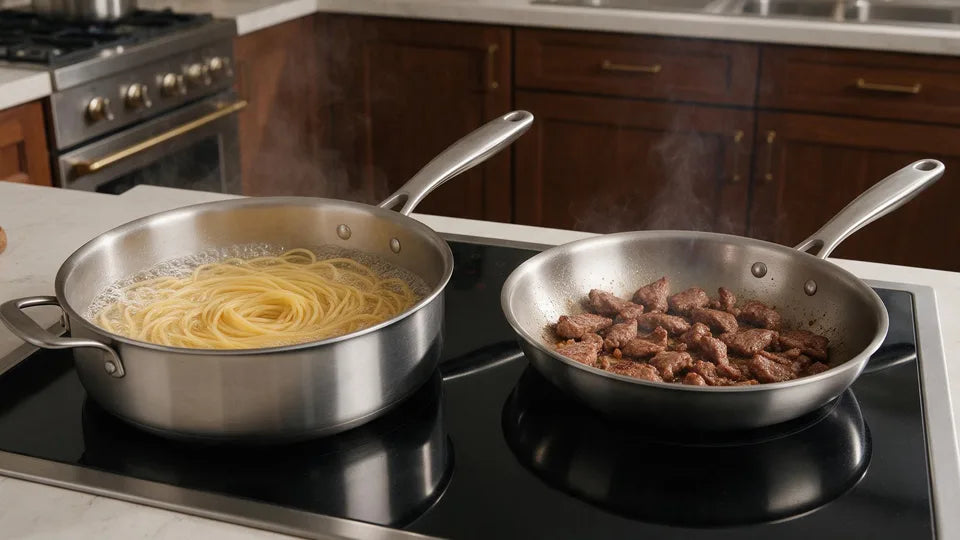
The central difference is wall geometry. A sauté pan keeps more of its width from the base to the rim, while a frying pan opens outward as its sides rise. That change affects usable capacity, utensil movement, evaporation, pouring, and the amount of cooking surface available within the same outside diameter.
Compare Straight and Flared Sides
Straight sides create a defined edge around the cooking surface. Ingredients are less likely to slide out while being stirred, and liquid has more room to rise without reaching the rim. This geometry is useful for dishes that begin with browning and continue with broth, tomatoes, wine, or another cooking liquid.
Flared sides give a spatula a lower angle of entry. They also help food move up and over the rim during a controlled toss. The tradeoff is that a frying pan generally provides less contained volume than a sauté pan with a similar top diameter.

Compare Depth and Cooking Access
Depth should be considered alongside wall angle. A deep frying pan may hold more than a shallow skillet, but its sloped walls still behave differently from the vertical walls of a sauté pan.
| Shape Detail | Sauté Pan | Frying Pan |
|---|---|---|
| Side profile | Straight or nearly vertical | Flared or sloped |
| Utensil access | More vertical at the edge | Easier low-angle access |
| Liquid containment | Strong | Moderate |
| Tossing motion | Possible but less fluid | Naturally supported by the slope |
| Common strength | Browning followed by simmering | Frying, turning, and quick reduction |
Which Pan Browns Food More Easily?
Both shapes can brown food well when their cooking surfaces are properly preheated, lightly oiled when needed, and not overcrowded. A frying pan often feels easier for turning individual pieces, while a sauté pan may offer a broad base that keeps several portions in one layer. Construction and heat control matter as much as shape.
Consider Evaporation and Turning Room
Flaring can expose more food and liquid to moving air, which may support faster reduction in some situations. However, evaporation is not determined by wall angle alone. Exposed surface area, temperature, airflow, humidity, and whether a lid is used all affect the rate. The U.S. Geological Survey identifies exposed surface area and temperature among the major factors in evaporation from water surfaces.
For steaks, cutlets, fish fillets, and vegetables, turning room can be more important than the nominal capacity. A frying pan's slope helps a spatula reach under food. A sauté pan can still brown effectively, particularly when its base is wide enough to keep ingredients separated.
Avoid Crowding Either Cooking Surface
Crowding traps moisture around food. Instead of escaping, released water collects and creates a wetter environment, which delays surface browning. This can happen in either shape, so a larger capacity label does not mean every ingredient should be added at once.
For more consistent browning:
- Dry the food surface when the recipe allows.
- Leave visible space between pieces.
- Brown in batches when one layer will not fit comfortably.
- Keep the residue brown rather than allowing it to turn black.
Which Pan Handles Liquids Better?
A sauté pan generally handles larger amounts of liquid more securely because its taller, straighter walls increase contained volume and reduce splashing. A frying pan remains useful for smaller pan sauces and rapid reduction, especially when easy whisk or spatula access matters more than capacity.
Contain Sauces With Taller Walls
Straight sides are helpful when a recipe moves from sautéing aromatics to adding stock, cream, tomatoes, or pasta water. The walls provide headroom for stirring and gentle bubbling. They also make a sauté pan suitable for shallow braises, saucy vegetables, and one-pan meals that would feel crowded in a low skillet.
A frying pan can still make a modest sauce, but its open shape gives bubbling liquid an easier path over the rim.

Use a Lid for Simmering When Included
A fitted lid slows moisture loss and helps maintain a steady covered simmer. It is useful when food needs time to soften or when the cook wants to retain more liquid. Removing the lid allows more vapor to escape, so the same pan can shift from covered cooking to reduction.
Lid inclusion must be checked on the exact product. Some pans are sold open, while others include a lid; the lid, knob, handles, and pan body may also have different oven limits.
Which Shape Fits Eggs and Delicate Food?
A frying pan is often the more convenient shape for eggs, crepes, fish, and other delicate foods because its flared wall improves utensil access. A sauté pan can cook the same foods, but the vertical edge may make sliding a wide spatula underneath them less comfortable.
Prioritize Spatula Access
An egg or thin fillet benefits from support across much of its underside. A shallow angle lets the spatula approach without pushing the food toward a wall. The curved transition found in many frying pans can also make it easier to slide finished food onto a plate.
A general frying pan can prepare pancakes or omelets without becoming specialized pancake or omelet cookware.
Use Moderate Heat for Controlled Release
Moderate heat gives delicate food time to set before it is turned. A small amount of suitable oil or fat may still be useful, even on a nonstick surface. Food release depends on temperature, timing, surface condition, and care rather than on the word “nonstick” alone.
The question “are ceramic pans safe?” cannot be answered by the material name alone. Safety depends on the exact food-contact formulation, intended use, condition, and manufacturer instructions. The FDA explains that substances used on food-contact surfaces, including cookware, are evaluated for their intended conditions of use. When cooking with ceramic coated pans, following the maker's heat, utensil, cooling, and cleaning guidance remains essential.

How Do Weight and Storage Compare?
A sauté pan may weigh more because it can have taller walls, a lid, and a helper handle. Filled weight and total handle span matter more than empty showroom weight.
Account for Helper Handles and Lids
A helper handle can make a filled sauté pan easier to support with two hands. It also adds width, and a large lid creates a separate storage task. Before buying, consider how the complete setup will move between the cooktop, oven, counter, and cabinet.
Useful handling checks include:
- Grip clearance for a dry oven mitt
- Balance when the pan contains liquid
- Clearance from nearby gas flames
- A stable location for the hot lid
- Enough oven space for both handles
Metal handles may become hot, particularly in the oven or near an adjacent burner. A “stay-cool” description should not replace careful use of a mitt when conditions can heat the handle.
Measure Cabinet Space
Measure the cabinet or drawer rather than estimating from pan diameter alone. Handles and the lid knob often determine whether a pan fits.
Cooktop fit deserves the same attention. The best pots and pans for a gas stove keep the flame beneath the base instead of letting it climb the sides. Utah State University Extension similarly recommends keeping cookware diameter close to burner diameter in its cook-surface guidance. Induction pots and pans require a flat magnetic base; the U.S. Department of Energy notes that compatible cookware should have a flat bottom to which a magnet will stick.
Can One Pan Replace the Other?
One pan can cover much of the other's work, but not every advantage. Sauté pans favor browning followed by substantial liquid; frying pans favor frequent turning, tossing, and low-angle utensil access.
Identify Meals Each Shape Handles Well
A sauté pan suits chicken with sauce, shallow braises, one-pan pasta, saucy vegetables, and larger batches of aromatics. A frying pan suits eggs, pancakes, cutlets, quick vegetables, fish fillets, and small pan sauces. Both can sear, sauté, fry, and reduce when size and technique are appropriate.
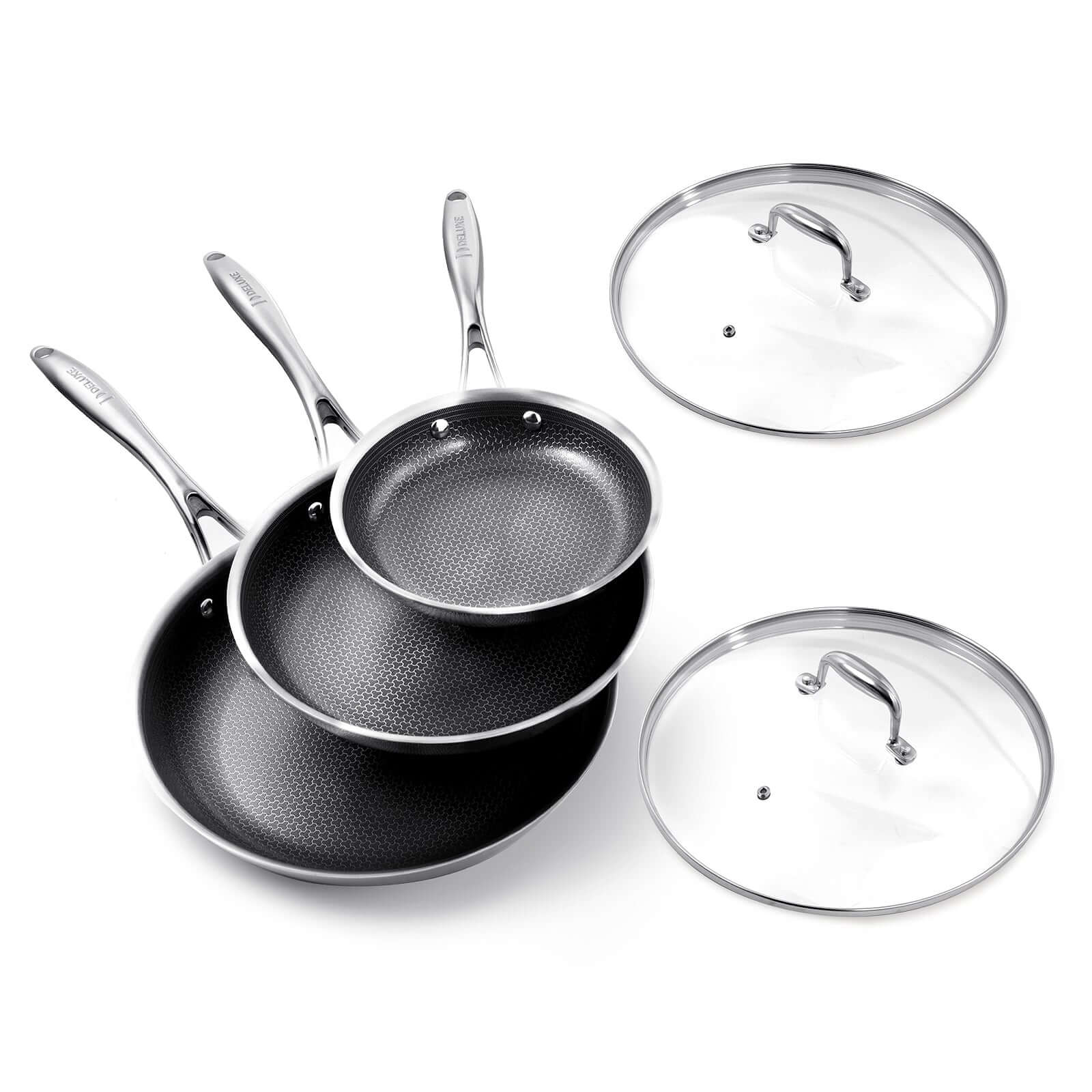
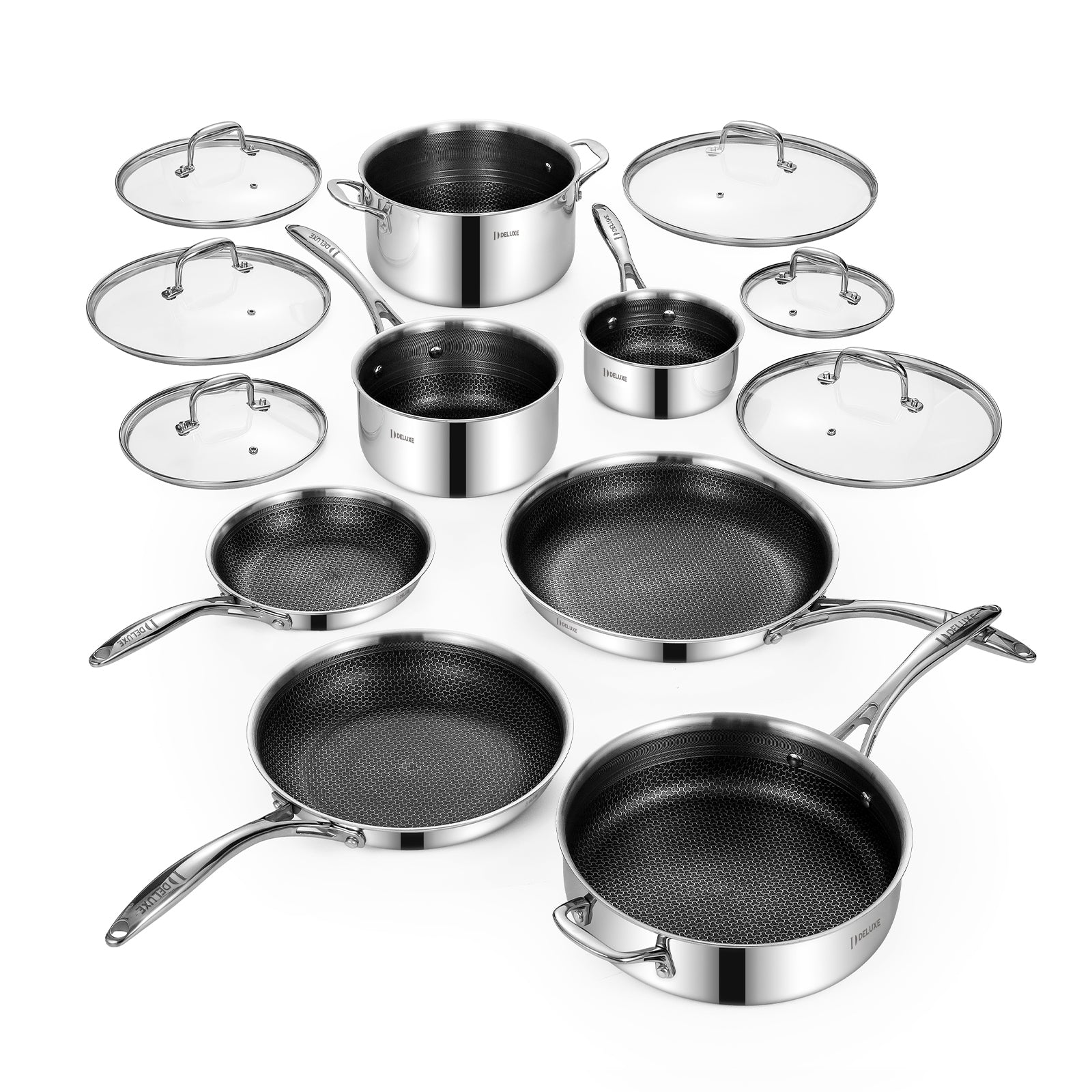
For cooks who want a lidded hybrid option, our 3.7 Qt Hybrid Sauté Pan with Lid combines a ceramic nonstick coating with a stainless steel structure. That construction should be described as hybrid cookware, not as a purely ceramic pan or a bare stainless steel pan.

Keep Both Only When Their Roles Differ
Owning both makes sense only when each solves a recurring task. If breakfast cooking and saucy covered meals rarely need different pans, one multipurpose shape may be sufficient.
A simple decision sequence can prevent duplicate purchases:
- List the meals cooked most often.
- Mark which meals need substantial liquid or a fitted lid.
- Mark which meals depend on easy turning or tossing.
- Compare filled weight, burner fit, and storage space.
- Choose a second shape only if it solves a repeated limitation.
Choose Between Cookware Sauté Pans and Frying Pans
Choose the shape around the meal rather than the category name. Straight sides favor sauces, larger volumes, and covered cooking; flared sides favor access, turning, and tossing. If both roles matter, compare our hybrid sauté pans and frying pans by capacity, lid inclusion, handle layout, cooktop fit, and storage needs. Whichever shape fits your routine, our use and care guidance supports gentle preheating and low to medium heat for everyday use.
Frequently Asked Questions About Sauté Pan vs Frying Pan
Q1: Which Pan Is Easier to Serve From at the Table?
It depends on the dish. A sauté pan can contain saucy food more securely, while a frying pan may make individual portions easier to lift with a spatula. Protect the table from heat, provide a suitable serving utensil, and keep hot handles away from diners.
Q2: Can Sauté Pans and Frying Pans Share the Same Lid?
Sometimes, but the same listed diameter does not ensure a secure fit. The rim shape and internal seating area must also match. Use a lid identified as compatible with the exact model rather than assuming that every 10-inch or 12-inch lid is interchangeable.
Q3: Can Acidic Ingredients Be Cooked in Either Pan?
It depends more on the cooking surface than on the pan’s shape. Tomatoes, citrus, and wine may be suitable for many coated or stainless steel surfaces, but prolonged contact can affect some materials. Follow the care instructions for the exact pan and avoid storing acidic food in it unless permitted.
Q4: What Should I Do if the Pan Starts to Wobble?
Stop and check whether the cooktop is level and the pan base is clean. If the base has warped, the pan may heat unevenly or sit unstably, especially on a smooth cooktop. Do not try to flatten cookware by striking or forcing the base.
Q5: Which Pan Is Easier to Clean After a Sticky Sauce?
Neither shape is automatically easier to clean. Cleanup depends more on the cooking surface, heat level, and residue. Allow the pan to cool before washing, then use warm soapy water and a soft sponge unless the exact care instructions recommend a different method.